
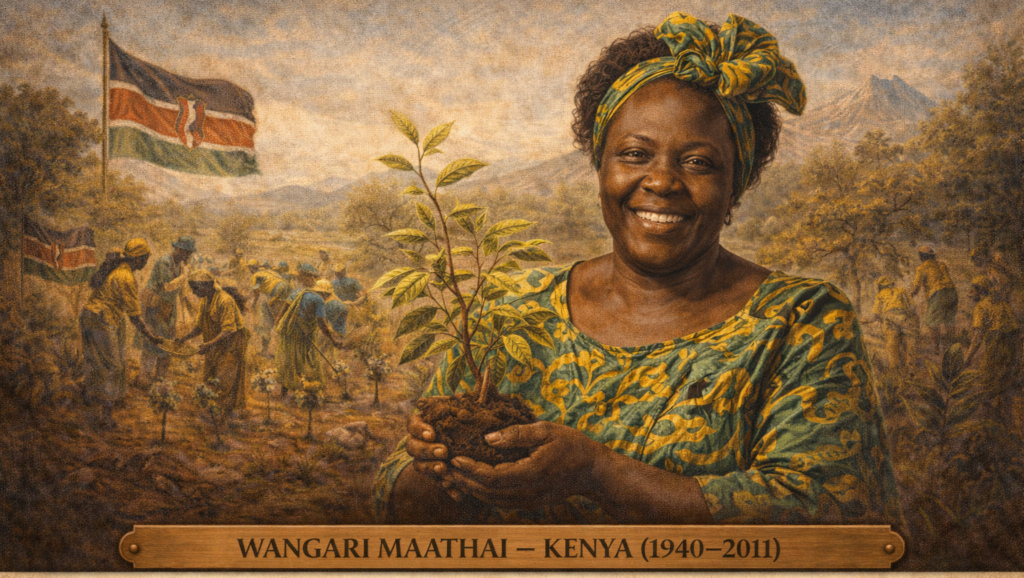
Wangari Maathai — Kenya (1940–2011)
Wangari Maathai was a Kenyan environmentalist, political activist, and human rights advocate who became internationally known for linking environmental conservation, women’s empowerment, and social justice. Through her work in Kenya, she demonstrated how protecting the environment is closely connected to defending human dignity and sustainable development.
She was the founder of the Green Belt Movement, a grassroots initiative that mobilized rural women to plant trees, restore ecosystems, and support their communities.
Historical Context
After independence in 1963, Kenya faced challenges related to deforestation, land degradation, and economic inequality.
Rural communities, particularly women, were heavily affected by environmental decline, which reduced access to firewood, clean water, and fertile soil.
During the 1970s, awareness grew about the need to address environmental issues alongside social and economic development.
Wangari Maathai emerged as a leader who connected environmental protection with human rights and community well-being.
Civic Virtue and Leadership
In 1977, Maathai founded the Green Belt Movement, encouraging women to plant trees to combat deforestation and improve their livelihoods.
The movement empowered thousands of women by providing income, education, and a sense of civic participation.
Maathai’s leadership emphasized grassroots action, community responsibility, and the importance of protecting natural resources for future generations.
She also became involved in political activism, advocating for democratic reforms, environmental protection, and government accountability.
Righteous Act: Linking Environmental Protection with Human Rights
Wangari Maathai’s most significant contribution was her creation of a movement that combined environmental conservation with social justice.
Through large-scale tree planting and community organizing, she helped restore degraded land while empowering women economically and socially.
She also spoke out against land misuse, deforestation, and government policies that threatened public resources.
Her work demonstrated that environmental sustainability is deeply connected to human rights, peace, and economic stability.
In recognition of her efforts, she was awarded the Nobel Peace Prize in 2004, becoming the first African woman to receive the honor.
Challenges and Adversity
Wangari Maathai faced significant opposition from political authorities and powerful interests.
Her activism led to arrests, physical confrontations, and public criticism, especially when she challenged government decisions related to land and environmental policies.
Despite these obstacles, she continued her work, advocating for both environmental protection and democratic reform.
Her resilience highlighted the challenges faced by activists working at the intersection of environment and politics.
Legacy
Wangari Maathai is remembered as a pioneer of environmental activism and a champion of sustainable development.
The Green Belt Movement continues her work, having planted millions of trees and inspired similar initiatives worldwide.
Her legacy reflects moral courage, innovation, and the belief that individual and community action can lead to meaningful global change.
References
Maathai, W. (2006). Unbowed: A memoir. Alfred A. Knopf.
Maathai, W. (2010). Replenishing the earth: Spiritual values for healing ourselves and the world. Doubleday.
Anderson, D. M. (2005). Histories of the hanged: The dirty war in Kenya and the end of empire. W. W. Norton & Company.
United Nations Environment Programme. (2004). Wangari Maathai and the Green Belt Movement.