
Wen Tianxiang — China (1236–1283)
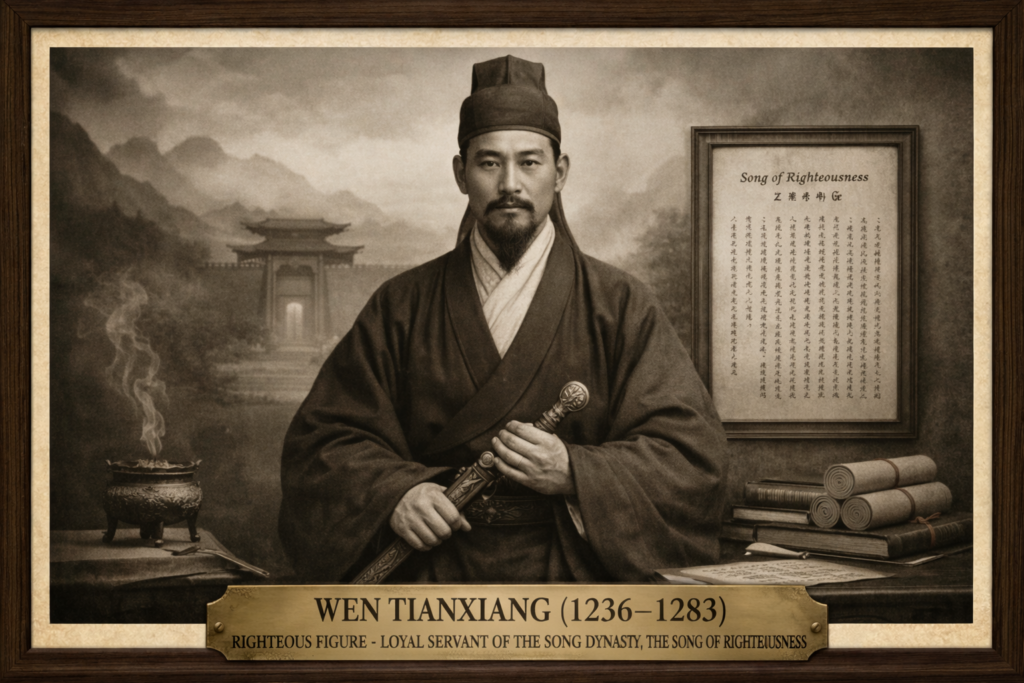
Wen Tianxiang was a scholar, statesman, and military leader of the Southern Song dynasty. He is widely remembered in Chinese history as a symbol of loyalty, integrity, and moral courage during a time of national crisis.
During the final years of the Song dynasty, Wen Tianxiang resisted the advancing Mongol forces of the Yuan Empire. Despite defeat and eventual capture, he refused to surrender his principles or serve the new ruling power. His steadfast commitment to loyalty and righteousness made him one of the most revered moral figures in Chinese history.
His life and writings, especially his famous poem “Song of Righteousness” (Zhengqi Ge), continue to inspire ideals of honor, patriotism, and moral integrity.
Historical Context
Wen Tianxiang lived during the decline of the Southern Song dynasty, a period marked by military conflict with the expanding Mongol Empire, which would later establish the Yuan dynasty in China.
After passing the imperial examination with the highest honors in 1256, Wen entered government service. As the Mongol forces advanced southward, the Song court faced increasing political instability and military defeats.
During the final struggle of the dynasty in the late thirteenth century, Wen Tianxiang took on leadership roles in organizing resistance against the Mongol armies, attempting to defend the sovereignty of the Song state.
Civic Virtue and Leadership
Wen Tianxiang’s leadership was guided by the Confucian ideals of loyalty, righteousness, and duty to the state. Even as the Song dynasty faced collapse, he remained committed to defending the legitimate government and protecting the moral order he believed it represented.
His actions reflected the traditional Confucian belief that a righteous official must remain faithful to moral principles even in the face of overwhelming adversity. Wen Tianxiang’s example became a powerful symbol of ethical conduct in Chinese political and cultural traditions.
His writings during this period emphasized the importance of moral integrity over personal survival, a theme that would define his legacy.
Righteous Act: Refusal to Surrender
One of the most defining moments of Wen Tianxiang’s life occurred after he was captured by Mongol forces in 1278. The Yuan authorities repeatedly offered him high office and favorable treatment if he would agree to serve the new regime.
Wen Tianxiang refused these offers, choosing instead to remain loyal to the fallen Song dynasty. During his imprisonment, he composed the famous poem “Song of Righteousness” (Zhengqi Ge), which celebrated the enduring spirit of moral righteousness.
Despite years of imprisonment and pressure to change his allegiance, Wen Tianxiang continued to reject all attempts to persuade him to abandon his principles. In 1283, he was executed in the Yuan capital.
His unwavering commitment to loyalty and righteousness transformed him into a lasting symbol of moral courage and integrity in Chinese history.
Challenges and Adversity
Wen Tianxiang faced extreme political and military adversity during the final years of the Song dynasty. The Mongol armies possessed overwhelming military strength, and the Song government struggled to maintain stability.
After being captured, Wen Tianxiang endured years of imprisonment, during which he faced repeated attempts to persuade him to submit to the new regime. Despite the hardship and uncertainty of his situation, he remained steadfast in his convictions.
His perseverance during captivity demonstrated a deep commitment to honor, loyalty, and moral duty, even when faced with the loss of freedom and ultimately his life.
Legacy
Wen Tianxiang is remembered as one of the most powerful symbols of loyalty and righteousness in Chinese history. His life story became an enduring example of the Confucian virtues of integrity, courage, and moral steadfastness.
His poem “Song of Righteousness” has been studied and recited for centuries as an expression of moral resilience and devotion to principle. Monuments, temples, and historical writings continue to commemorate his legacy across China.
Today, Wen Tianxiang is honored not only as a historical figure but also as a timeless representation of ethical conviction and unwavering righteousness.
References
Ebrey, P. B. (2010). The Cambridge illustrated history of China (2nd ed.). Cambridge University Press.
Mote, F. W. (1999). Imperial China 900–1800. Harvard University Press.
Peterson, B. (2002). Wen Tianxiang. In B. Peterson (Ed.), The Cambridge history of China: Volume 5, Sung China, 960–1279 (pp. 873–875). Cambridge University Press.
Tianxiang, W. (2003). Song of righteousness (Zhengqi Ge). In V. H. Mair (Ed.), The Columbia anthology of traditional Chinese literature. Columbia University Press.