
William Wilberforce — United Kingdom (1759–1833)
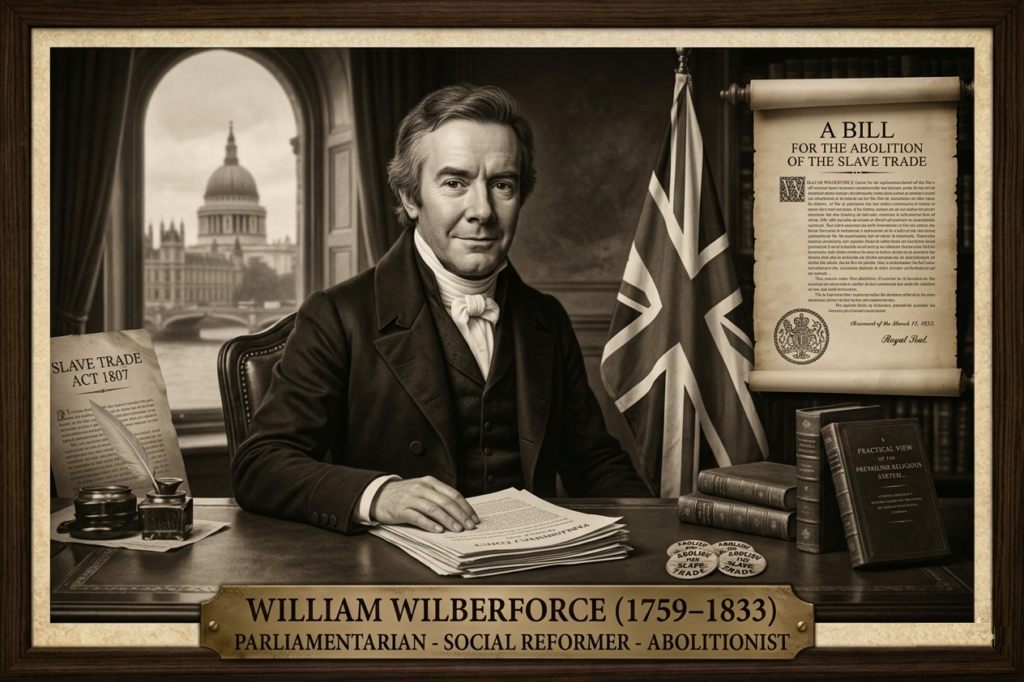
William Wilberforce was a British parliamentarian, social reformer, and leading abolitionist who dedicated much of his life to ending the transatlantic slave trade. His persistent efforts in the British Parliament helped bring about one of the most significant moral reforms in modern history.
For more than two decades, Wilberforce led a parliamentary campaign to abolish the slave trade within the British Empire. Despite repeated political defeats, he remained committed to the principle that human dignity and freedom must be protected by law.
His leadership ultimately contributed to the passage of the Slave Trade Act of 1807, which abolished the British slave trade and marked a major milestone in the global movement against slavery.
Historical Context
During the late eighteenth and early nineteenth centuries, the transatlantic slave trade was a central component of the global economy. Millions of Africans were forcibly transported to the Americas and subjected to slavery under European colonial systems.
At the time, many political and economic leaders defended the slave trade as necessary for economic prosperity. However, growing religious, moral, and humanitarian movements in Britain began to challenge this system.
Wilberforce emerged as a key leader in this reform movement. Working closely with activists such as Thomas Clarkson, he helped bring the issue of slavery into the national political debate and mobilized public support for abolition.
Civic Virtue and Leadership
Wilberforce believed that political leadership carried a responsibility to defend moral principles and human rights. After undergoing a profound religious transformation in the 1780s, he devoted his career to social reform.
In Parliament, Wilberforce became the principal advocate for ending the slave trade. He introduced multiple abolition bills, delivered influential speeches, and worked to persuade fellow legislators that the slave trade violated fundamental moral and humanitarian values.
His leadership extended beyond Parliament as well. Through collaboration with reform groups, churches, and public campaigns, Wilberforce helped build a broad coalition dedicated to the cause of abolition.
Righteous Act: The Campaign to Abolish the Slave Trade
Wilberforce’s most significant contribution to history was his long and determined campaign to abolish the British slave trade.
Beginning in 1789, he repeatedly introduced legislation to end the trade in enslaved people. These proposals faced strong opposition from powerful commercial interests that benefited from slavery.
For nearly twenty years, Wilberforce continued the struggle despite numerous defeats in Parliament. His persistence helped maintain national attention on the moral injustice of slavery.
Finally, in 1807, the British Parliament passed the Slave Trade Act, which prohibited British ships and merchants from participating in the slave trade. The act represented a historic step toward ending slavery and helped influence abolition movements throughout the world.
Challenges and Adversity
Wilberforce’s campaign encountered significant political resistance. Many members of Parliament were connected to colonial plantation economies and opposed abolition because of economic concerns.
He also endured personal challenges, including serious health problems and political isolation during the early years of the movement.
Despite these obstacles, Wilberforce remained committed to the cause. His perseverance demonstrated a profound belief that moral conviction must guide public policy, even when facing powerful opposition.
Legacy
William Wilberforce is remembered as one of the most influential leaders in the global abolition movement.
His work helped transform public opinion about slavery and demonstrated that moral advocacy within democratic institutions can produce profound social change.
Following the abolition of the slave trade in 1807, the broader campaign to end slavery continued. Just days before Wilberforce’s death in 1833, the British Parliament passed the Slavery Abolition Act, which began the process of abolishing slavery throughout most of the British Empire.
Today, Wilberforce’s legacy stands as a powerful example of ethical leadership, perseverance, and the pursuit of justice in public life.
References
Hague, W. (2008). William Wilberforce: The life of the great anti-slave trade campaigner. HarperPress.
Hochschild, A. (2005). Bury the chains: Prophets and rebels in the fight to free an empire’s slaves. Houghton Mifflin.
Tomkins, S. (2007). William Wilberforce: A biography. Lion Hudson.
Walvin, J. (2007). A short history of slavery. Penguin Books.