
Yamato Takeru — Japan (77–111)
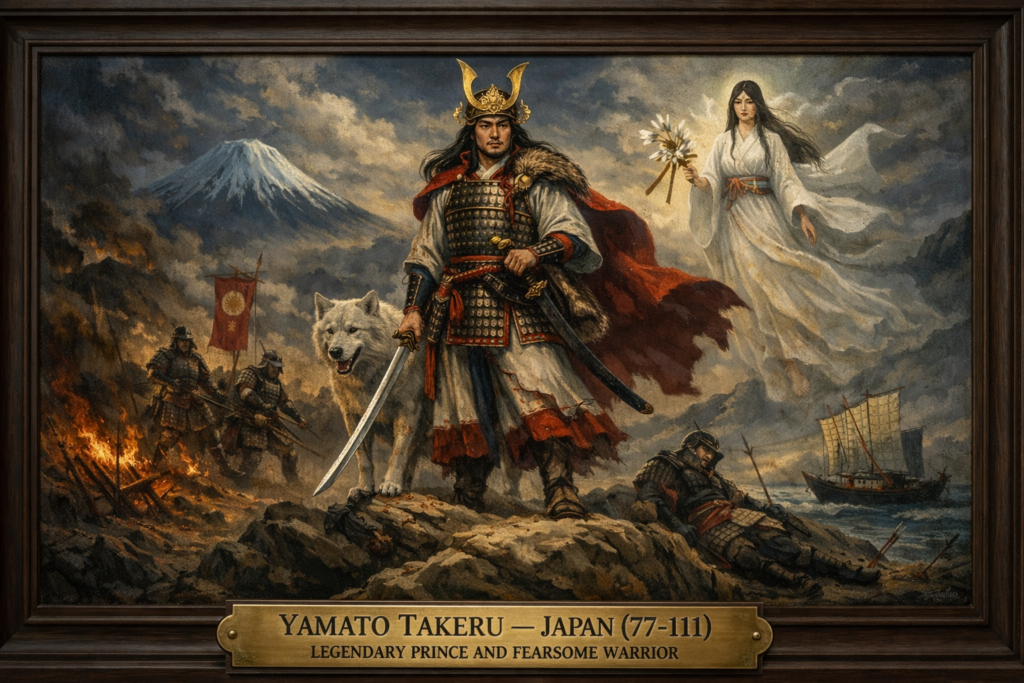
Yamato Takeru was a legendary Japanese prince and warrior who appears in early Japanese historical chronicles and mythology. Celebrated for his bravery, loyalty, and devotion to duty, he became one of the most famous heroic figures in early Japanese tradition.
According to classical texts, Yamato Takeru was a son of the emperor and carried out important military campaigns to expand and secure imperial authority across parts of the Japanese archipelago. His story reflects ideals of courage, honor, and righteous leadership that influenced later Japanese cultural traditions.
Although elements of his life are considered legendary, Yamato Takeru’s story has remained an enduring symbol of heroic virtue, sacrifice, and commitment to duty in Japanese history and folklore.
Historical Context
The stories of Yamato Takeru appear in some of Japan’s earliest historical and mythological records, including the Kojiki and the Nihon Shoki.
These texts describe the early formation of the Yamato state, an emerging political authority that sought to unify different regions of Japan under imperial rule.
During this early period, various regional clans and tribes held significant local power. Military expeditions were often undertaken to consolidate authority and establish order.
Within this environment, Yamato Takeru is portrayed as a prince who undertook difficult missions to bring rebellious regions under imperial control and maintain stability within the realm.
Civic Virtue and Leadership
In Japanese tradition, Yamato Takeru is remembered for his loyalty to the imperial court and his willingness to carry out difficult tasks for the good of the nation.
One well-known episode describes how he disguised himself in order to defeat hostile leaders who threatened imperial authority. This story highlights his strategic intelligence, bravery, and resourcefulness.
Another famous episode involves the legendary sword Kusanagi-no-Tsurugi, one of the sacred treasures of Japan. According to tradition, Yamato Takeru used the sword to escape a deadly grass fire set by his enemies, cutting down the burning grass to create a path to safety.
These stories portray Yamato Takeru as a leader who combined courage, clever strategy, and dedication to duty.
Righteous Act: Defending the Realm
Yamato Takeru’s most celebrated actions involve the military campaigns he conducted to defend and expand the authority of the early Japanese state.
According to traditional accounts, he was sent by the emperor to subdue rebellious groups that threatened stability in different regions of Japan.
During these campaigns, Yamato Takeru is portrayed as acting not merely as a warrior but as a defender of order, loyalty, and political unity. His missions were seen as efforts to protect the stability of the realm and ensure the authority of the imperial government.
Although the historical accuracy of these stories remains debated by historians, the narrative of Yamato Takeru represents the ideal of a leader who acts with courage, loyalty, and commitment to the greater good.
Challenges and Adversity
The legends of Yamato Takeru also emphasize the hardships he faced during his campaigns. He encountered dangerous enemies, harsh landscapes, and repeated threats to his life.
According to tradition, his long military journeys eventually weakened his health. During his return from one of his campaigns, he fell seriously ill.
Before his death, the stories say that his spirit transformed into a white bird, symbolizing his continuing presence and heroic legacy within Japanese culture.
This symbolic transformation reinforced the idea that Yamato Takeru’s courage and spirit would endure beyond his lifetime.
Legacy
Yamato Takeru remains one of the most celebrated heroic figures in Japanese mythology and early history.
His story has influenced literature, theater, and cultural traditions for centuries. Many shrines and historical sites across Japan are associated with his legendary journeys.
Through these stories, Yamato Takeru represents enduring cultural ideals of courage, loyalty, honor, and devotion to duty.
Although modern historians recognize that many elements of his life are legendary, the narrative of Yamato Takeru continues to inspire reflections on heroic virtue and righteous leadership within Japanese cultural heritage.
References
Aston, W. G. (Trans.). (2005). Nihongi: Chronicles of Japan from the earliest times to A.D. 697. Tuttle Publishing.
Philippi, D. L. (Trans.). (2015). Kojiki. Princeton University Press.
Varley, H. P. (2000). Japanese culture: A short history. University of Hawai‘i Press.
Kidder, J. E. (1993). Early Japanese civilization. Thames & Hudson.